Wednesday 5 March 202518.00–19.30
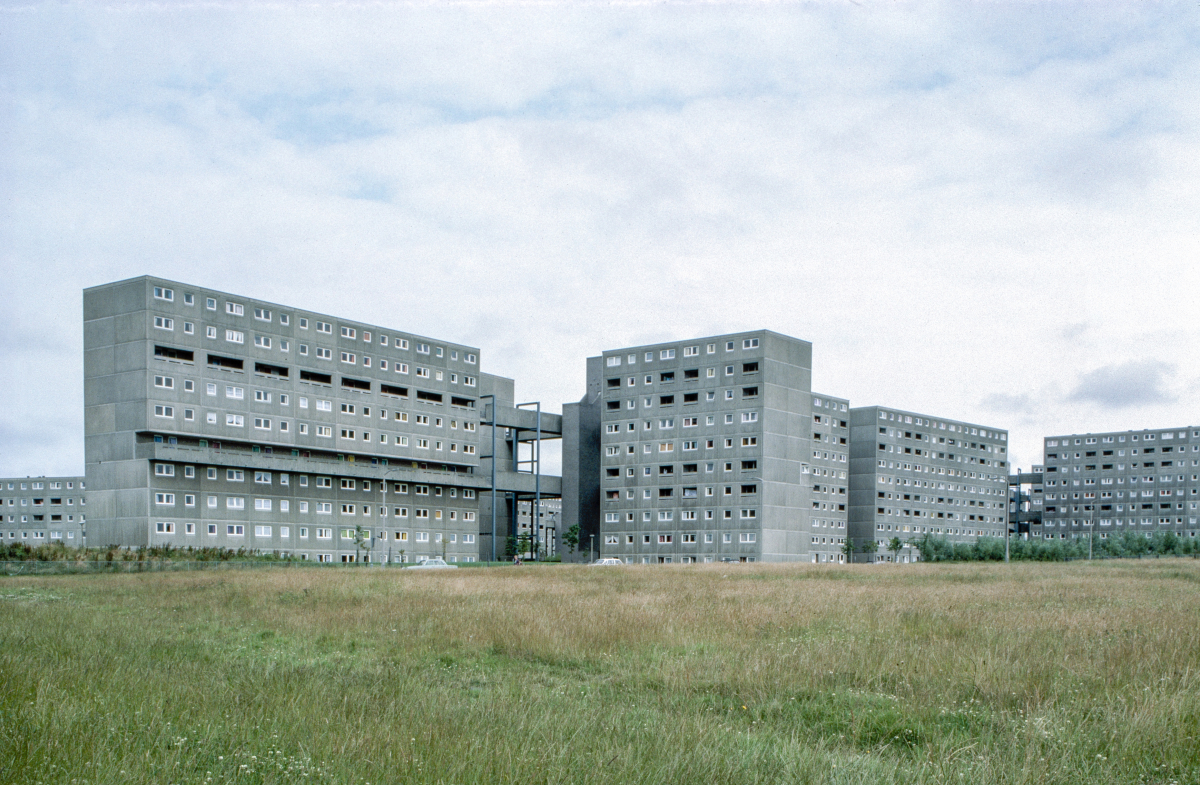
Can we align Brutalism’s boldness and transformative energy to an ecological agenda?
Over the last fifteen years, Brutalism has experienced an extraordinary revival and reassessment: from being near universally reviled to becoming the subject of numerous books and exhibitions, and featuring in everything from art prints to tea towels. Beyond the simple allure of moody, black and white photographs of concrete, the way Brutalist buildings stand as powerful evidence of a fundamentally different political, economic and social settlement to that of today has attracted a lot of interest among those looking for alternatives today.
More recently, a growing number of commentators have pointed out that Brutalist buildings, alongside their social or political associations, also stand as the built embodiments of an era that assumed energy would be cheap and plentiful in perpetuity – with heating, cooling and ventilation resolved by mechanical means. As a result, Brutalist buildings are some of the most – if the most – carbon intensive buildings ever to be built in terms of both embodied and operational carbon, and in many ways stand almost as a celebration of the age of oil.
This event explores how we might reconcile this paradox, taking the boldness and transformative energy of Brutalism and aligning it to an ecological agenda – and establish what me might call an Eco-Brutalism. Can we reimagine Brutalism’s original qualities and ideals – material honesty, addressing the city as found, its imagistic aspects – in ways that are carbon neutral or carbon negative?
Creative adaptive reuse of Brutalist buildings or otherwise is obviously core to this, but the discussion will also encompass new build (where necessary) that makes use of natural materials from timber and stone, to emerging bio-material and techniques. If Brutalism celebrated the formal potentials of reinforced concrete and energy profligacy, is there an equivalent approach for natural materials that narrates their formal and aesthetic potentials and carbon efficiency?
Speakers
Florian Urban – Professor of Architectural History and Head of History of Architectural and Urban Studies at the Glasgow School of Art. Author with Barnabas Calder of Architecture and Fuel – 14 Buildings from Antiquity to the Oil Age (Routledge, 2025).
Niki-Marie Jansson – Principal at NM Jansson Studio; Associate Lecturer and PhD candidate at the School of Architecture, Planning and Landscape at the Newcastle University. Her work explores the progressive architectural possibilities of stone in modern construction, aiming to develop techniques for specifying indigenous stone types in “whole” masonry constructional assemblies for housebuilding in the UK.
Jane Scott – Newcastle University Academic Track Fellow (NUAcT) who leads The Living Textiles Research Group in the Hub for Biotechnology in the Built Environment in the School of Architecture Planning and Landscape. Located at the interface of programmable materials, knitted fabric design, architecture and biology, Jane’s research positions textiles as a critical biofabrication strategy in the transition to sustainable and circular construction.
Alex Scott-Whitby – Director of ScottWhitbyStudio; Associate Professor of Architecture at Kingston University. A particular focus of Alex’s work is on the adaptive reuse of historic buildings, with current projects including the rejuvenation of The Church House in Westminster, a Grade II-listed office and civic building designed by Herbert Baker and a new sustainable public space outside St Paul’s Cathedral.
Part of ‘This Was The Future’ – a series where expert speakers tackling the big questions and key issues around Tyneside’s 1960s and 1970s transformations.
If you are unable to attend this event, you can listen to a recording once the event has passed here.
Image credit: Killingworth Towers, c. 1980. Image Courtesy of Amber Collective
Date
Wednesday 5 March 2025
Time
18.00–19.30
Location
The Sir Terry Farrell Building
Eldon Place
Newcastle upon Tyne
NE1 7RD United Kingdom
Cost
Free
Booking Information
Free
Booking via Eventbrite